
Getting started
- Create your academy: sign up, setup wizard, tax details and plan
- How courses, subjects and units fit together
- Migrate from other platforms: Moodle, Canvas, Blackboard, Google Classroom, Thinkific or Teachable
- Import a Moodle course (.mbz): units, files, assignments and quizzes
- Import a course from Canvas, Blackboard, Schoology or D2L (Common Cartridge)
- Import a course from Thinkific (API)
- Import a course from Teachable (API)
- Import a course from LearnWorlds (API)
- Migrate from Kajabi
- Migrate from Skool
- Visual or vertical mode: choose how students see your academy
Subjects and content
- Add lessons, videos and required reading to a subject
- Upload and compress videos: up to 20 GB, automatic compression and fast playback
- Live classes and 1:1 tutoring with Zoom, Google Meet or Teams
- Document viewers: PDF, Word, PowerPoint, Excel and code inside your academy
- Interactive activities: match, order, fill in the blanks and word search
Questions and exams
- Practice bank vs. exam bank: question types, including SAT-style grid-ins
- Import questions from CSV or Excel (with grid-in answers)
- Create timed exams: practice tests, practice exams and official exams
- Written-answer questions (short and essay) and manual grading
- Gradebook and grade weights: how the final grade is calculated
- Generate questions with Quiddy (syllabi, laws and math)
- Question challenges: when a student reports a wrong question
- Practice tests vs. official exams: how tests work and their settings
- Sequential practice: a unit's question bank, one by one
- Set a close date for exams and unit tests
Assignments and certificates
Students and teachers
Calendar and statistics
Email marketing
Website, domain and SEO
- Design your student area: styles, logo, colors, home and menu
- Add a banner and choose the student home layout
- Build and publish your website with the Website Builder
- Connect your own domain (CNAME or A record) with automatic HTTPS
- SEO and Google Search Console: sitemap, robots.txt and site verification
- Design your sign-in and sign-up pages: 14 layouts with your image and text
- FAQs for your students and visitors: help center, order and FAQ rich results
- WordPress plugin: sell your courses and add single sign-on
Connect your domain
- Connect your domain: step-by-step guides by provider
- Connect a GoDaddy domain to your academy (DNS records)
- Connect a Namecheap domain to your academy (Advanced DNS)
- Connect a Squarespace domain (formerly Google Domains)
- Connect a Cloudflare domain to your academy (DNS only)
- Connect a Hostinger domain to your academy (hPanel DNS)
- Connect an IONOS domain to your academy (DNS records)
- Connect a Porkbun domain (DNS records, ALIAS and TXT)
- Connect a Network Solutions domain (Advanced DNS)
- Connect a Bluehost domain (DNS tab and Advanced DNS records)
- Connect a domain bought at Wix (DNS records, no nameserver change)
- Connect a DonDominio domain (DNS zone, CNAME and ANAME)
- Connect an Arsys domain (DNS entries in the Control Panel)
Payments and coupons
Account, plan and security
- Your Acatudy subscription: plans, prices, invoices and canceling
- Storage and plan limits: what counts, where to see it and how to free up space
- Keep your account secure: passwords, sessions and signing out
- Privacy, cookies and student data (GDPR): what Acatudy does for you
- API tokens: connect your store or website, renew and revoke
- Backups: what your plan includes and how to restore your academy
- Trash: restore deleted questions, topics, units and exams
- What each AI task costs in AI Tokens
Support
No guide titles match. Press Enter to search inside the guides too.
Set a close date for exams and unit tests
Give an exam a deadline: after the close date nobody can start it, and anyone already taking it can finish. How to set it, the countdown students see and how it works with solutions and the calendar.
On this page
In this topic 10
- Practice bank vs. exam bank: question types, including SAT-style grid-ins
- Import questions from CSV or Excel (with grid-in answers)
- Create timed exams: practice tests, practice exams and official exams
- Written-answer questions (short and essay) and manual grading
- Gradebook and grade weights: how the final grade is calculated
- Generate questions with Quiddy (syllabi, laws and math)
- Question challenges: when a student reports a wrong question
- Practice tests vs. official exams: how tests work and their settings
- Sequential practice: a unit's question bank, one by one
- Set a close date for exams and unit tests
In this guide
- What the close date does.
- Set it on an exam or unit test.
- The countdown students see.
- Solutions, calendar and imports.
What the close date does
The Exam date is when an exam opens. The close date is when it stops accepting new attempts. From that moment no student can start it; anyone who had already started can finish within their time limit. Without a close date, the exam stays open.
Set a close date
-
Open the exam
Go to Courses → Exams (in vertical mode, open the subject) and click the edit button (pencil) on the exam or unit test. You can also set the close date when you create it.
-
Fill in Close date and time
In Close date and time (optional), pick the day and time. It uses your academy's time zone and must be after the exam date; otherwise you'll see “The close date must be after the exam date.”
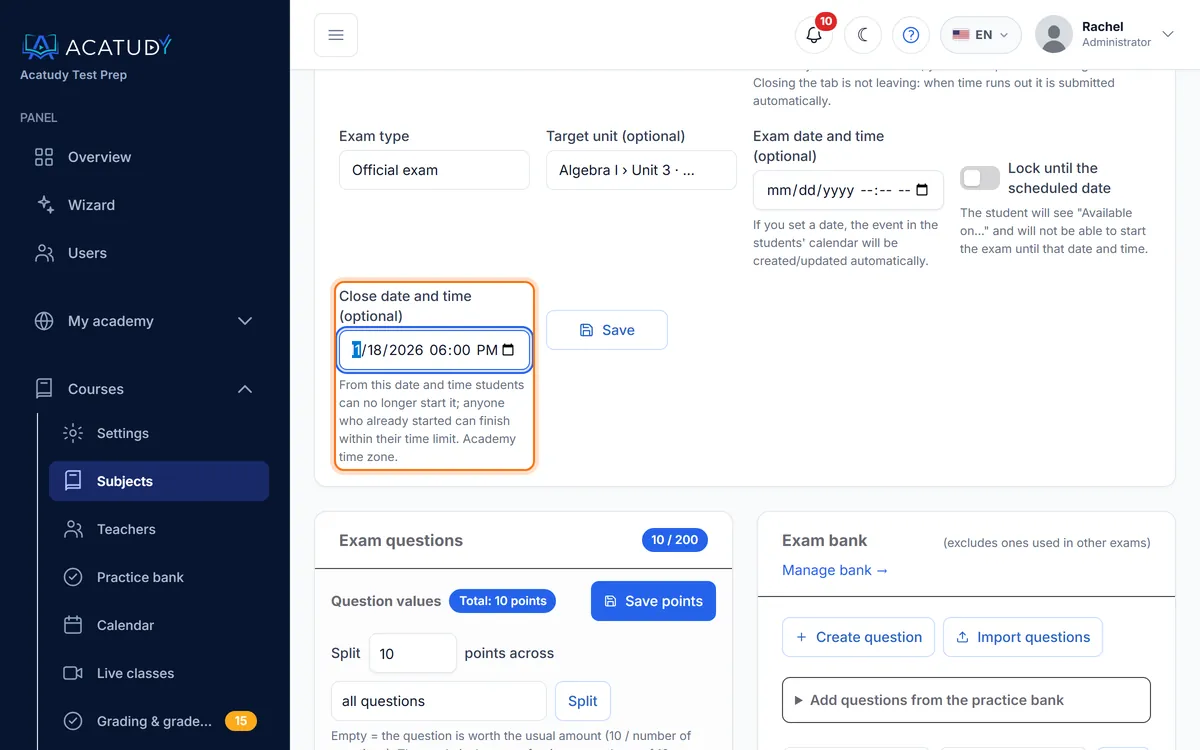
The Close date and time field in the exam settings. -
Save
Click Save. Students see the deadline straight away. To remove it, empty the field and save again.
What students see
A countdown while it's open
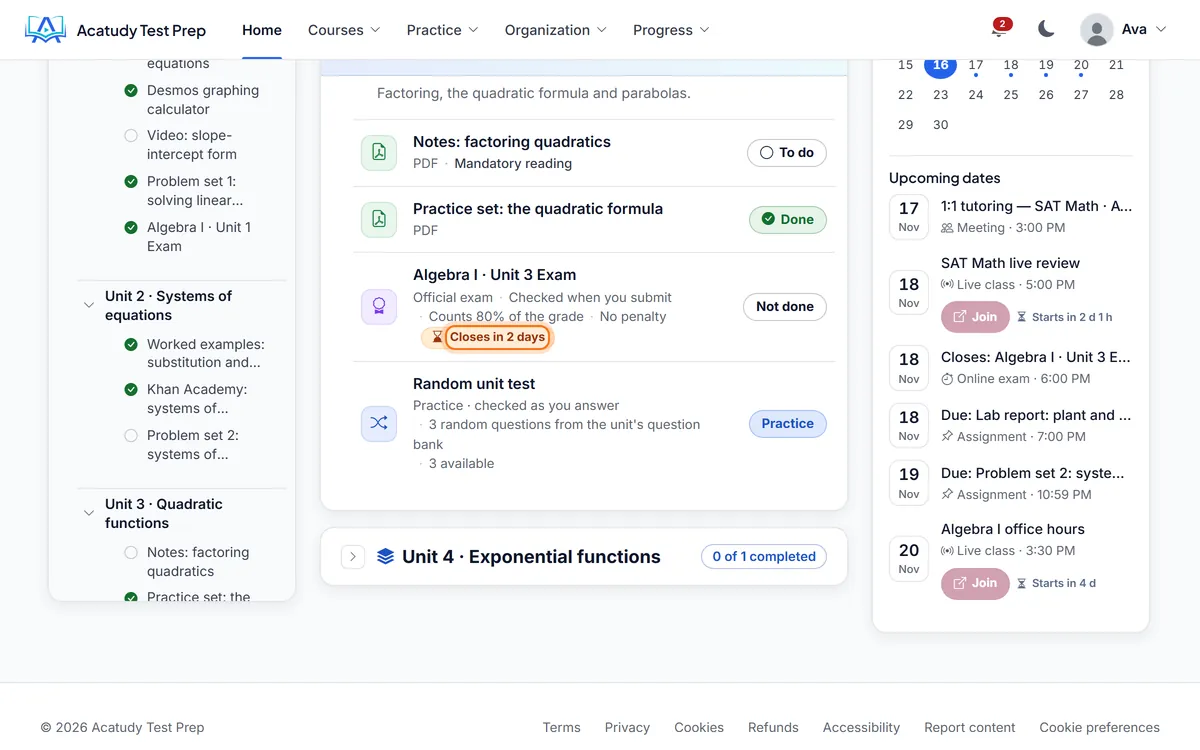
Next to the exam, in the unit and in the exam list, students see how long is left, for example Closes in 2 days or Closes in 5 hours. The color changes as the date gets closer: green with more than a week, then yellow, orange in the last three days and red in the last 24 hours. The Pending panel shows “Closes on …” and the calendar adds a “Closes: exam title” event.
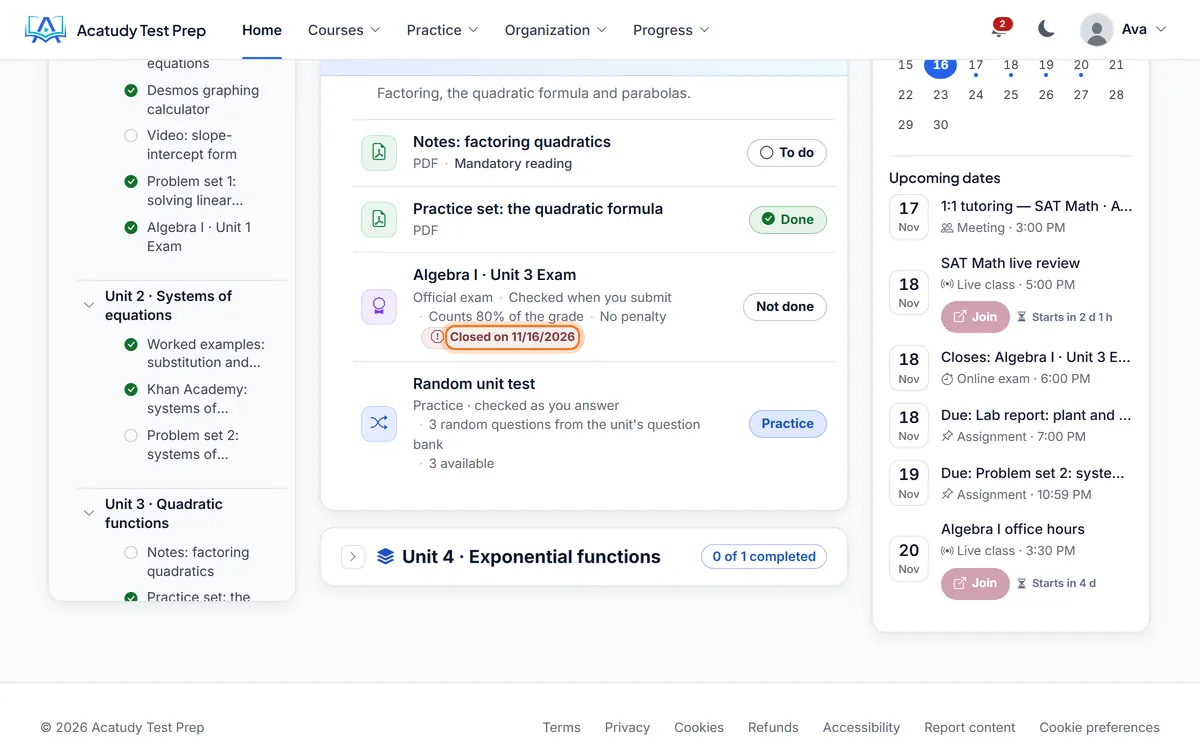
Closed
Once the date passes, the exam shows Closed on and the date, it leaves the Pending panel and students can't start new attempts. If they try, they see that it closed and when.
Solutions, calendar and imports
- Solutions: under When students see the solutions, choose When the exam closes for them (no attempts left or exam closed) to show them only after the deadline, once everyone who was taking it has finished.
- Calendar: the closing event is created and updated automatically.
- Moodle imports: a quiz's future close time becomes the exam's close date. Cloning a course keeps it.
Opening and closing
Combine it with Lock until the scheduled date to open and close an exam on fixed dates, for example from Monday 8:00 AM to Friday 6:00 PM.
Frequently asked questions
A student started five minutes before the close. Is the attempt cut off?
No. They can finish within the exam's time limit.
Can I reopen a closed exam?
Yes. Set a later close date, or empty the field, and save.
Where do I set the rest of the exam?
See Create timed exams.
Follow this guide in your own academy
Create it free in a couple of minutes on the Free plan: it never expires and needs no credit card. Keep the dashboard open next to this guide.
Open a ticket from Help → Support in your panel: we reply within 24–48 h depending on your plan.